1 on 1 Email: A Complete Guide for Small Businesses
June 7, 2026
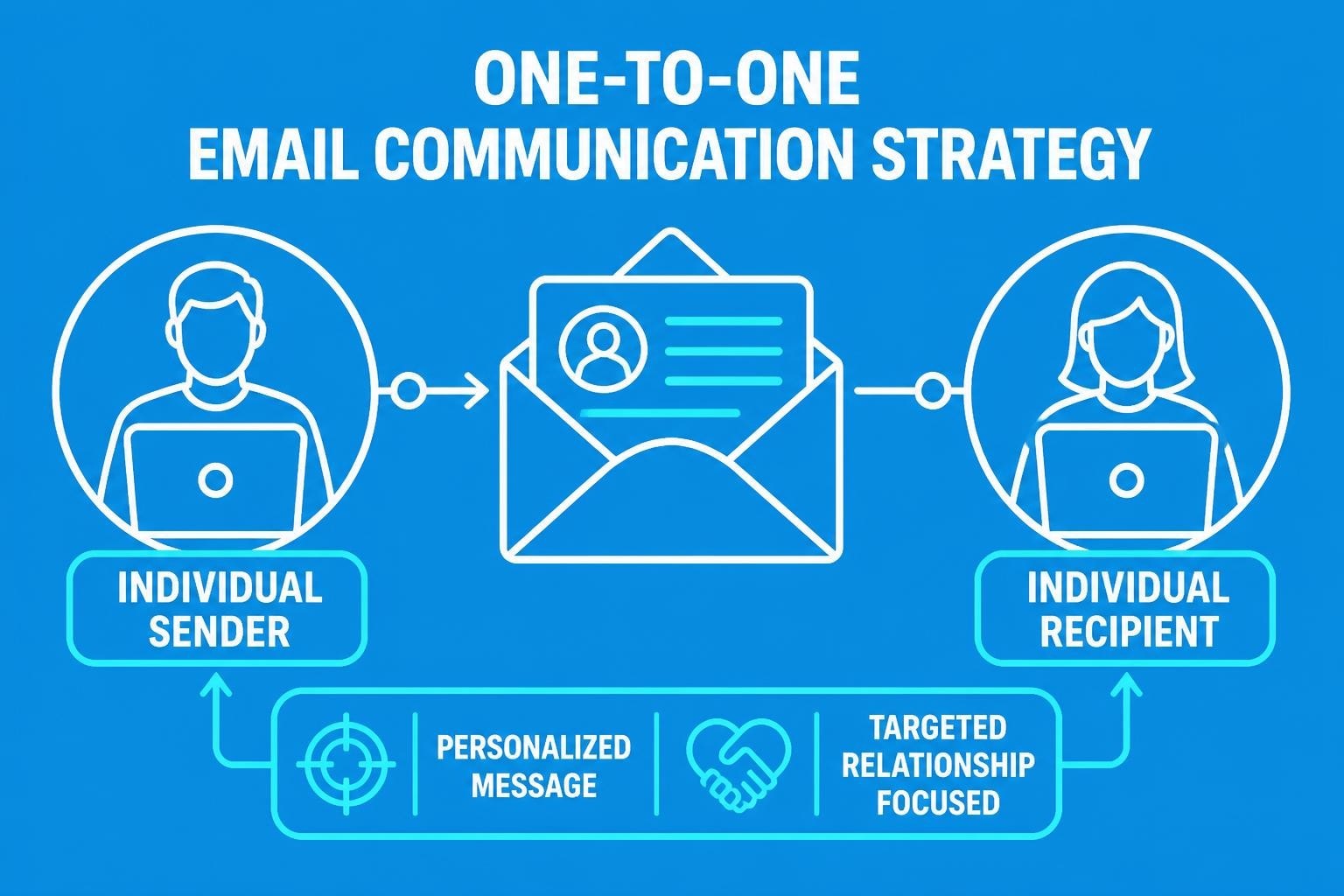
The digital marketing landscape has evolved dramatically over recent years, yet one principle remains constant: personal connection drives results. For small businesses competing against larger enterprises, the ability to create meaningful, individualised relationships through email marketing represents a significant competitive advantage. The 1 on 1 email approach transforms standard bulk messaging into personalised conversations that resonate with recipients on a human level, fostering trust and driving meaningful engagement. This targeted methodology enables businesses to move beyond generic campaigns and establish authentic connections that translate into customer loyalty and increased conversions.
Understanding the 1 on 1 Email Approach
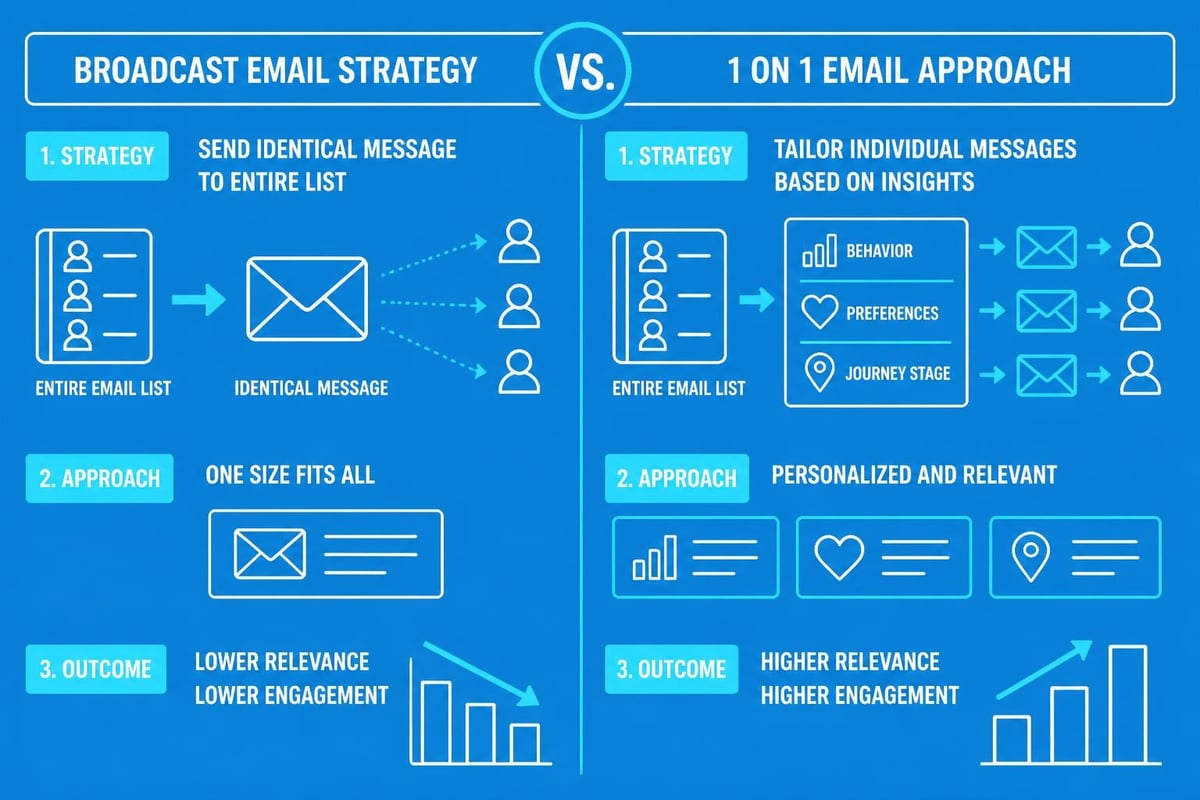
The concept of 1 on 1 email centres on treating each recipient as an individual rather than a segment within a larger database. Unlike traditional broadcast emails that deliver identical messages to thousands of subscribers, this approach customises content, timing, and messaging to align with each recipient's specific needs, behaviours, and preferences.
Small businesses particularly benefit from this strategy because:
- Limited resources make relationship quality more important than quantity
- Personal touch differentiates from corporate competitors
- Higher conversion rates justify the additional effort
- Customer lifetime value increases through stronger relationships
- Referral opportunities multiply when customers feel valued
The distinction between personalisation and true 1 on 1 email communication lies in depth. Whilst personalisation might insert a recipient's name into a template, genuine one-to-one email crafts messages that reflect understanding of individual customer journeys, pain points, and aspirations. Effective email personalization strategies demonstrate how this approach transforms engagement metrics across industries.
Why Traditional Bulk Emails Fall Short
Mass email campaigns operate on a broadcast model that assumes all recipients share similar interests and motivations. This approach produces declining engagement rates as audiences become increasingly sophisticated and expect relevance. Research indicates that generic bulk emails often achieve open rates below 20%, with click-through rates struggling to exceed 2-3%.
The primary failures of conventional bulk messaging include:
- Generic content that fails to address individual circumstances
- Poor timing that ignores recipient time zones and behavioural patterns
- Irrelevant offers that don't match customer lifecycle stages
- Impersonal tone that feels automated and disconnected
- Overwhelming frequency that treats all subscribers identically
Implementing 1 on 1 Email in Your Small Business
Transitioning from bulk campaigns to individualised communication requires strategic planning and the right technological foundation. Small businesses must balance personalisation ambitions with practical resource constraints, making efficiency crucial to sustainable implementation.
Building Your Data Foundation
Effective 1 on 1 email communication depends entirely upon quality data collection and organisation. Without robust customer information, personalisation remains superficial and ineffective. Begin by establishing comprehensive data collection processes across all customer touchpoints.
Essential data categories include:
| Data Type | Examples | Application |
|---|---|---|
| Demographic | Age, location, job title, industry | Message customisation, timing |
| Behavioural | Purchase history, website visits, email engagement | Content relevance, product recommendations |
| Preference | Communication frequency, content interests, channel choices | Delivery optimisation, topic selection |
| Transactional | Order values, purchase frequency, category preferences | Offer personalisation, loyalty rewards |
Consider implementing progressive profiling, which gradually collects information over multiple interactions rather than overwhelming new subscribers with lengthy forms. This approach respects customer time whilst building comprehensive profiles that inform increasingly sophisticated 1 on 1 email campaigns.
The email system you choose for small business operations should facilitate seamless data integration and provide intuitive segmentation capabilities that enable true individualisation at scale.
Segmentation as the Gateway to Individualisation
Whilst true 1 on 1 email addresses individuals, practical implementation often begins with sophisticated segmentation. Creating highly specific audience segments allows businesses to deliver personalised messages efficiently whilst maintaining the individual focus that drives engagement.
Advanced segmentation moves beyond basic demographic divisions to incorporate behavioural triggers, engagement patterns, and customer lifecycle stages. For instance, separating customers who abandoned carts in the past 24 hours from those who did so two weeks ago enables distinctly different messaging approaches, each tailored to the specific time elapsed and likely recipient mindset.
Effective segmentation strategies:
- Combine multiple data points for precise targeting
- Create dynamic segments that update automatically
- Develop lifecycle-based segments reflecting customer journey stages
- Implement engagement-based groupings separating active from dormant subscribers
- Establish value-based tiers recognising high-value customers
Crafting Truly Individual Messages
The hallmark of successful 1 on 1 email lies not in technology but in message quality. Each communication should feel as though written specifically for the individual recipient, reflecting their unique relationship with your business.
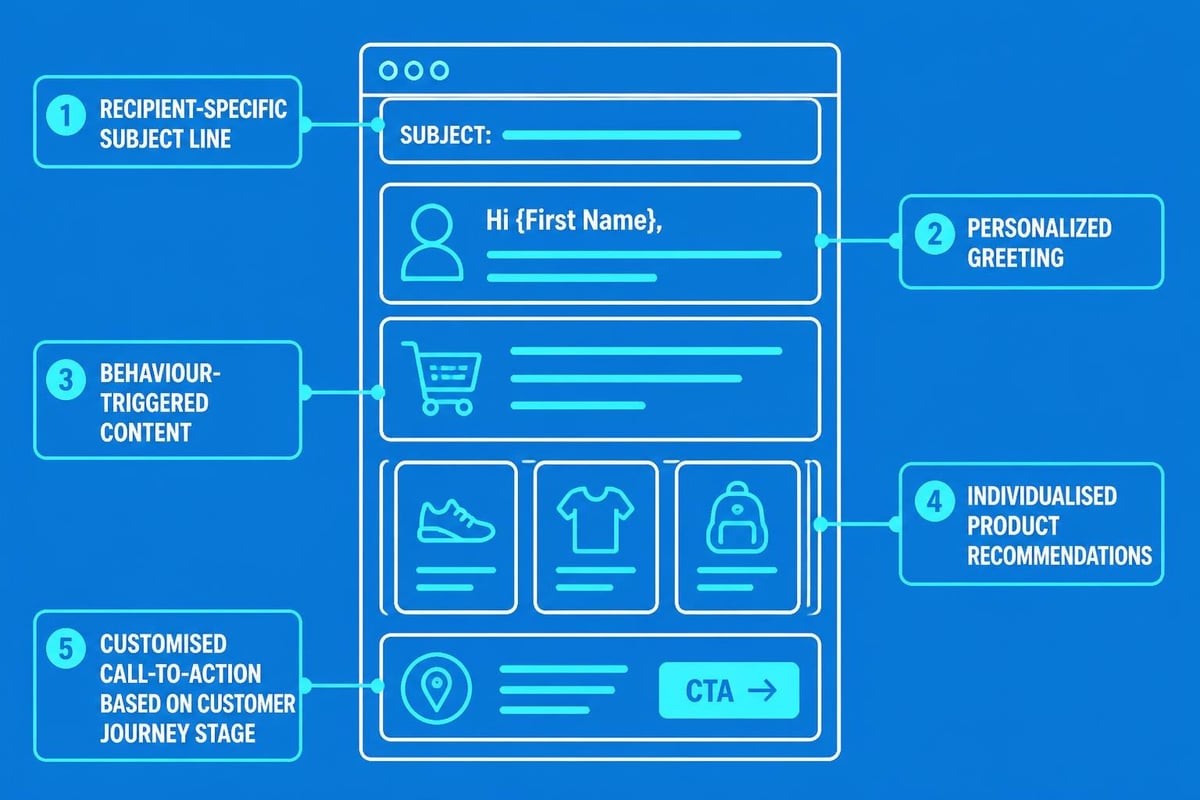
Begin by addressing specific customer actions or circumstances. Rather than generic "We thought you'd like this" messaging, reference actual browsing behaviour, previous purchases, or expressed interests. This demonstrates attention and creates immediate relevance.
Expert advice on crafting professional emails emphasises matching tone to recipient expectations whilst maintaining authentic human voice throughout communications.
Consider message length carefully. Research on email length best practices suggests shorter messages often perform better, particularly for mobile readers who comprise the majority of email users in 2026.
Advanced Techniques for 1 on 1 Email Success
Moving beyond basic personalisation requires sophisticated approaches that leverage automation whilst maintaining individual focus. Modern email marketing platforms enable businesses to scale personal touches without proportionally increasing manual effort.
Behavioural Trigger Campaigns
Automated workflows triggered by specific customer actions represent the pinnacle of scalable 1 on 1 email marketing. These campaigns respond to individual behaviours in real-time, delivering relevant messages precisely when recipients are most receptive.
Common behavioural triggers include:
- Browse abandonment: Sending product reminders when visitors view items without purchasing
- Cart abandonment: Following up within hours when customers leave items in baskets
- Post-purchase: Delivering usage tips, complementary product suggestions, or review requests
- Milestone celebrations: Acknowledging anniversaries, birthdays, or achievement markers
- Engagement changes: Re-engaging dormant subscribers or rewarding highly active ones
Each trigger should initiate a sequence of messages, not just a single email. For example, cart abandonment might trigger an initial reminder after two hours, a second message with a small incentive after 24 hours, and a final attempt after three days. This sequence respects individual decision-making timelines whilst maintaining connection.
Dynamic Content Insertion
Dynamic content technology enables sending a single campaign that displays different content blocks to different recipients based on their profiles and behaviours. This approach combines the efficiency of bulk sending with the relevance of 1 on 1 email personalisation.
Rather than creating separate campaigns for each segment, dynamic content pulls appropriate images, copy blocks, product recommendations, and offers based on recipient data. A clothing retailer might showcase different products based on gender, previous purchase categories, or browsing history, all within the same campaign deployment.
Implementation considerations:
- Start with simple dynamic elements like product recommendations
- Gradually expand to dynamic subject lines and preview text
- Test dynamic versus static content to measure performance impact
- Ensure fallback content exists for recipients with incomplete data
- Monitor rendering across email clients to prevent display issues
Predictive Personalisation
Advanced 1 on 1 email strategies incorporate predictive analytics that anticipate customer needs before they express them. Machine learning algorithms analyse historical patterns to forecast future behaviours, enabling proactive rather than reactive messaging.
Predictive models might identify customers likely to churn, enabling preventive outreach before disengagement occurs. Similarly, algorithms can predict optimal send times for individual recipients based on their historical engagement patterns, ensuring messages arrive when recipients are most likely to open and act.
Measuring 1 on 1 Email Performance
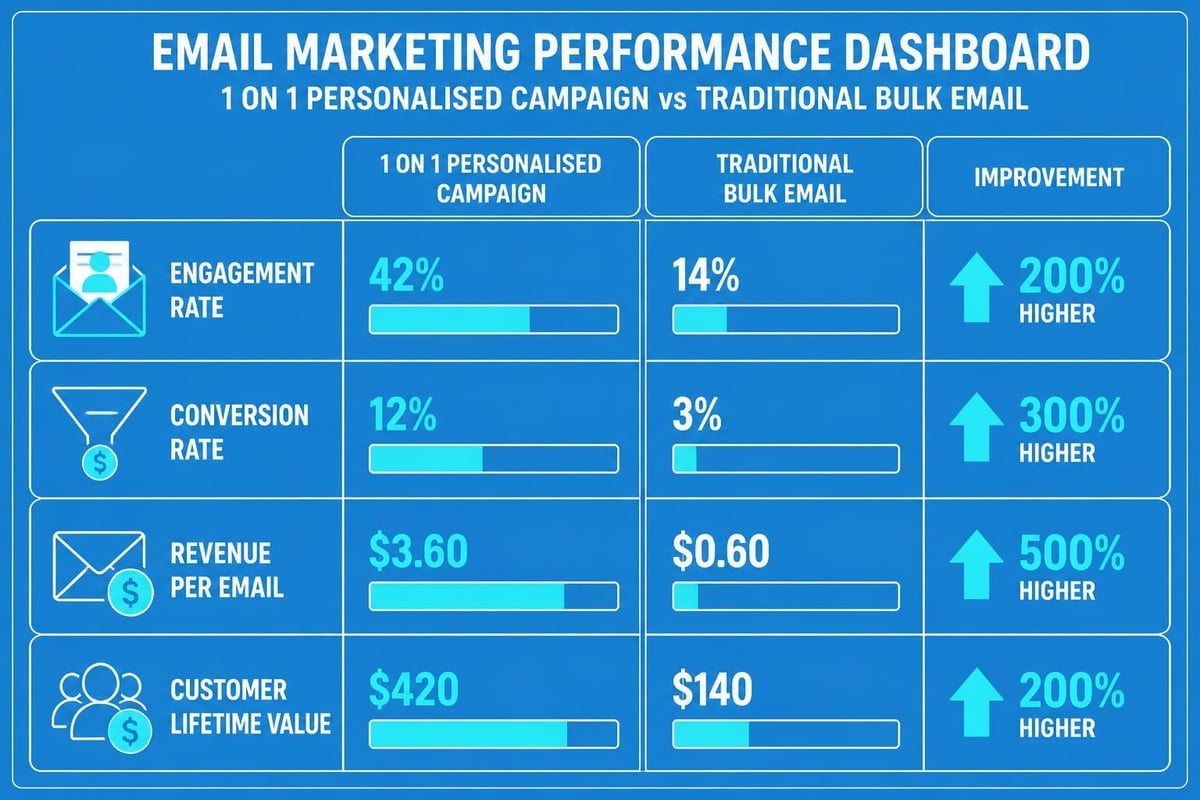
Success in personalised email marketing requires moving beyond standard metrics to measures that reflect relationship quality and individual engagement depth. Whilst open rates and click-through rates remain relevant, they tell an incomplete story about one-to-one communication effectiveness.
Key Performance Indicators for Personalised Campaigns
| Metric | What It Measures | Target Benchmark |
|---|---|---|
| Engagement Rate | Opens + clicks combined | 15-25% |
| Conversion Rate | Actions completed per email | 2-5% |
| Revenue Per Email | Average income generated | Varies by industry |
| List Growth Rate | Net subscriber additions | 2-5% monthly |
| Email Sharing Rate | Forwards and social shares | 1-3% |
Beyond quantitative metrics, qualitative indicators provide valuable insights into 1 on 1 email relationship building. Monitor reply rates, as responses indicate recipients view your emails as genuine communication rather than marketing noise. Track customer lifetime value changes for highly personalised segments versus control groups receiving standard messaging.
A/B Testing for Continuous Improvement
Even highly personalised 1 on 1 email campaigns benefit from systematic testing. The personalisation approach itself becomes a variable to optimise through controlled experimentation.
Test personalisation depth by comparing moderately personalised messages against deeply individualised versions. Sometimes simple personalisation (name, location, general preferences) performs equally well as complex customisation, enabling resource reallocation to other priorities.
Elements worth testing:
- Subject line personalisation intensity
- Message length variations
- Tone formality levels
- Content block arrangements
- Call-to-action personalisation
- Send time optimisation
For small businesses with limited list sizes, testing requires patience. Rather than splitting small segments into tiny test groups, consider sequential testing where you trial one approach for a period before switching to an alternative and comparing results.
Overcoming Common 1 on 1 Email Challenges
Implementing individualised email marketing presents distinct obstacles that small businesses must navigate strategically. Understanding these challenges and preparing solutions ensures sustainable success rather than abandoned initiatives.
Resource Constraints and Scalability
The primary concern surrounding 1 on 1 email revolves around resource requirements. Many small business owners assume personalisation demands prohibitive time investment, particularly when managing communications manually.
The solution lies in strategic automation that handles repetitive personalisation tasks whilst preserving opportunities for genuine human touches. Automated workflows manage routine triggered messages, freeing time for truly individual outreach to high-value customers or critical moments in customer relationships.
Email marketing platforms designed for small businesses provide automation capabilities previously available only to enterprises, democratising sophisticated personalisation technology.
Data Privacy and Trust
Effective 1 on 1 email depends on customer data, yet consumers increasingly scrutinise how businesses collect and use personal information. Balancing personalisation benefits against privacy concerns requires transparency and ethical data practices.
Always obtain explicit consent before collecting personal information and communicate clearly how data will be used. Provide straightforward opt-out mechanisms and honour preferences immediately. When customers trust your data practices, they willingly share information that enables better personalisation, creating a virtuous cycle.
Maintaining Authenticity at Scale
The fundamental tension in 1 on 1 email marketing involves maintaining genuine personal connection whilst serving hundreds or thousands of customers. Automation risks creating communications that feel manufactured despite personalisation elements.
Preserve authenticity by:
- Writing in conversational, human voice
- Acknowledging the automated nature when appropriate
- Encouraging replies and responding personally when received
- Sharing genuine stories and behind-the-scenes insights
- Admitting mistakes and addressing them transparently
Remember that effective email outreach balances efficiency with genuine relationship building, never sacrificing authenticity for scale.
Building a 1 on 1 Email Strategy Roadmap
Successful implementation requires a phased approach that builds capability progressively rather than attempting comprehensive transformation immediately. Small businesses should develop realistic roadmaps aligned with their current resources and capabilities.
Phase One: Foundation Building
Begin by establishing essential infrastructure: data collection processes, email platform selection, and basic segmentation structures. Focus on capturing fundamental customer information and implementing simple personalisation elements like name insertion and basic purchase history references.
During this phase, audit your current email practices to identify quick wins. Perhaps you're already sending some individualised messages manually that could be automated, or existing campaigns could benefit from simple dynamic content additions.
Phase Two: Behaviour-Based Automation
Once foundational elements are functioning reliably, implement automated behavioural triggers. Start with highest-impact scenarios like cart abandonment or post-purchase sequences where personalisation demonstrably improves results.
Creating effective cold email sequences requires similar strategic thinking to behaviour-based campaigns, with emphasis on value delivery and relationship building over immediate conversion.
Phase Three: Advanced Personalisation
The final phase incorporates sophisticated techniques like predictive analytics, complex dynamic content, and AI-powered optimisation. At this stage, your 1 on 1 email programme operates efficiently at scale whilst maintaining individual focus throughout customer journeys.
Timeline considerations:
| Phase | Duration | Key Milestones |
|---|---|---|
| Foundation | 1-3 months | Platform setup, data collection, basic segments |
| Automation | 3-6 months | Triggered workflows, dynamic content, testing protocols |
| Advanced | 6-12 months | Predictive models, AI optimisation, full integration |
Integration with Broader Marketing Strategy
One-to-one email functions most effectively when integrated seamlessly with other marketing channels and customer touchpoints. Isolated email personalisation creates disconnected experiences if website, social media, and other communications remain generic.
Develop unified customer profiles that inform personalisation across all channels. When a customer browses specific products on your website, that behaviour should influence not only email content but also retargeting ads, social media interactions, and even customer service approaches.
Exploring resources on how to supercharge your email marketing campaign reveals integration opportunities that multiply the effectiveness of individual tactics through coordinated execution.
Consider implementing customer data platforms that consolidate information from multiple sources, creating comprehensive views that enable sophisticated personalisation without requiring customers to repeatedly share the same information. This approach respects customer time whilst enabling deeper individualisation.
The professional email approach you develop for 1 on 1 communications should reflect your broader brand voice whilst allowing for individual customisation that makes each recipient feel uniquely valued.
Mastering 1 on 1 email transforms small business marketing from broadcasting messages into building relationships, creating sustainable competitive advantages through genuine customer connection. When implementing these strategies with the right platform and consistent refinement, businesses achieve dramatically improved engagement, conversion rates, and customer loyalty. Astonish Email provides small businesses with the tools and capabilities needed to execute sophisticated personalised email marketing without enterprise-level budgets, making genuine one-to-one communication accessible and sustainable for growing companies.