1 Time Email: Complete Guide for Small Businesses 2026
May 20, 2026
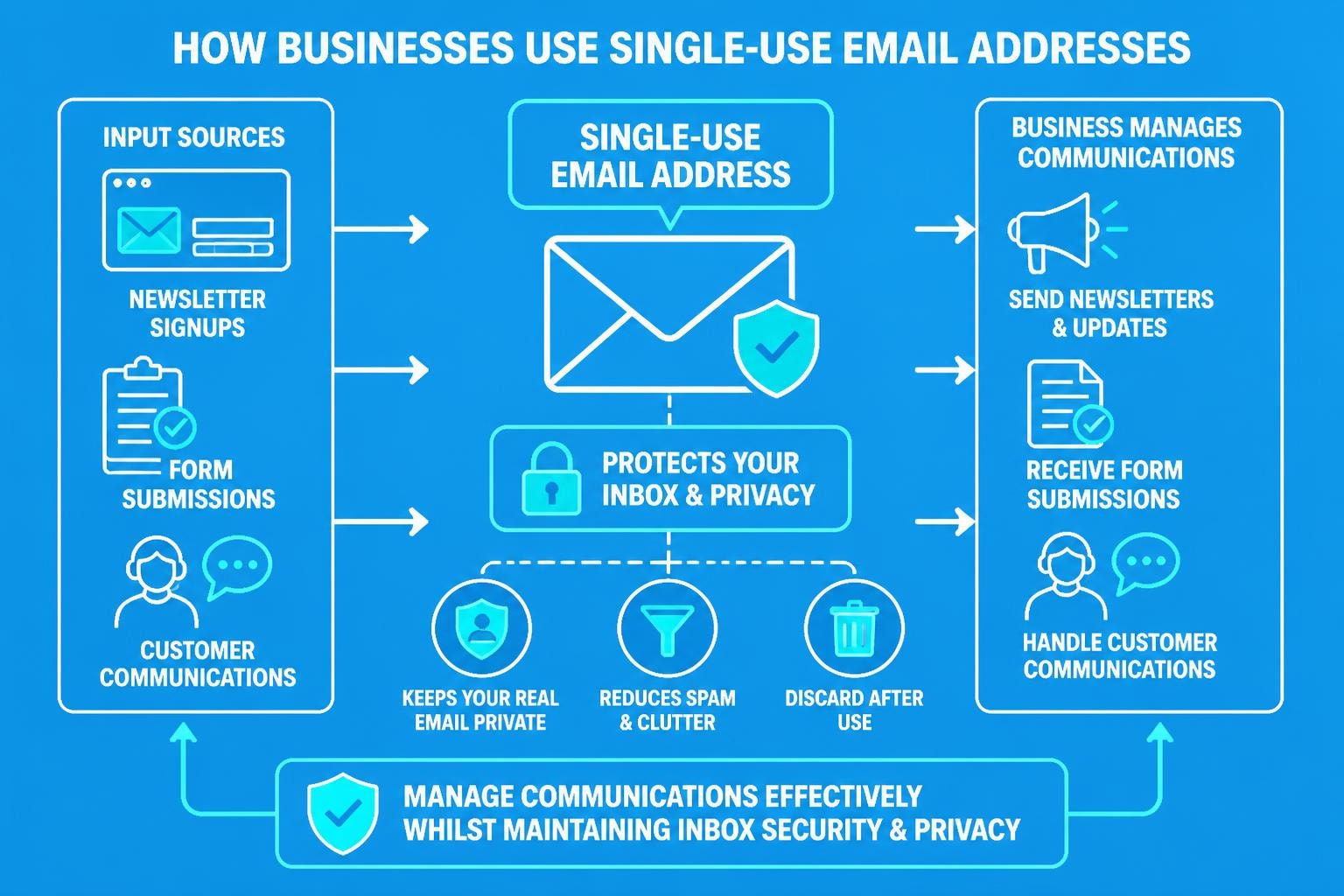
Small businesses face an ongoing challenge when managing email communications: protecting their primary inbox whilst exploring new marketing opportunities, testing services, and engaging with potential partners. A 1 time email address offers a strategic solution that safeguards your professional email reputation whilst enabling you to participate fully in the digital marketplace. This disposable approach to email management has evolved significantly since its inception, becoming an essential tool for businesses seeking to balance accessibility with security.
Understanding 1 Time Email Addresses
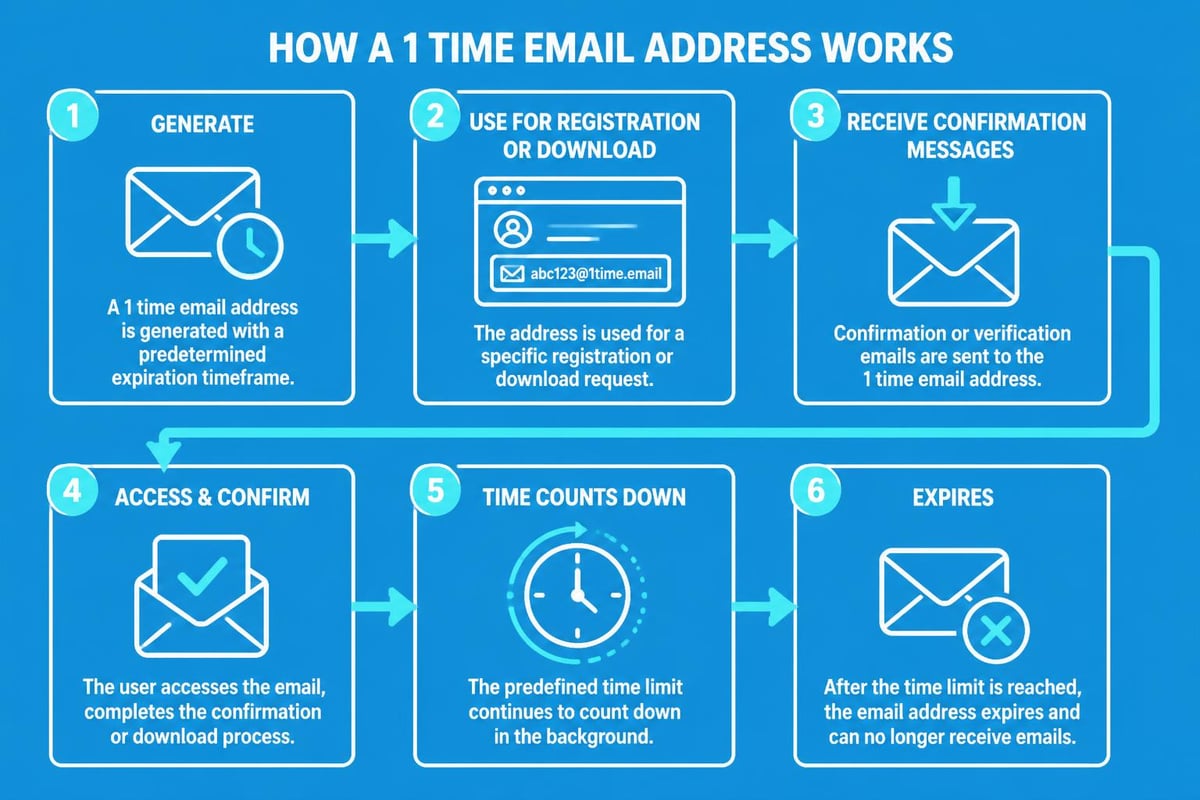
A 1 time email address serves a single, specific purpose before being discarded or automatically expiring. Unlike your permanent business email that you use for client communications and professional correspondence, these temporary addresses act as protective barriers between your primary inbox and the broader internet.
The fundamental principle behind 1 time email technology is straightforward: generate a unique email address for each transaction, registration, or interaction that doesn't require long-term communication. Once the immediate purpose is fulfilled, the address becomes inactive or gets deleted entirely.
Key characteristics of 1 time email include:
- Automatic expiration after a predetermined period
- No permanent storage of messages
- Protection against long-term spam accumulation
- Anonymous interaction capabilities
- Reduced digital footprint
Small businesses particularly benefit from this approach when testing new software platforms, signing up for industry webinars, or downloading gated content like whitepapers and market reports. Rather than exposing your primary business email to potential spam lists, you can evaluate opportunities without long-term consequences.
How 1 Time Email Differs from Traditional Temporary Email
Whilst the terms often get used interchangeably, 1 time email represents a specific subset of temporary email services. Traditional temporary email might remain active for hours or days, receiving multiple messages across various senders. A 1 time email, by contrast, is designed for a singular transaction or extremely limited use.
This distinction matters for businesses implementing security protocols. According to research on temporary email security practices, understanding the specific use case determines which type of temporary solution best serves your needs.
Strategic Business Applications for 1 Time Email
Marketing Campaign Testing
Before launching a full-scale email marketing campaign through platforms like Astonish Email, savvy small businesses test their content across multiple scenarios. Using 1 time email addresses allows marketing teams to:
- Subscribe to their own newsletters from various addresses
- Test automated welcome sequences and drip campaigns
- Verify deliverability across different email providers
- Check how emails render in various inbox environments
- Ensure unsubscribe mechanisms function properly
This testing methodology protects your primary business addresses from cluttering up with test messages whilst providing realistic subscriber experiences. When you're ready to send an email message to actual customers, you'll have confidence in your content's performance.
Vendor Evaluation and Software Trials
Every small business evaluates new tools and services regularly. Software vendors typically require email registration for trial accounts, demonstrations, or pricing information. Using 1 time email for these interactions prevents your main inbox from becoming overwhelmed with follow-up sales messages.
| Use Case | 1 Time Email Benefit | Long-term Impact |
|---|---|---|
| CRM trials | Isolate onboarding emails | No future marketing clutter |
| Webinar registrations | Receive access links only | Avoid perpetual newsletters |
| Competitor research | Anonymous signup capability | Maintain privacy |
| Industry tools testing | Separate evaluation communications | Clean primary inbox |
The strategic advantage becomes apparent when you're simultaneously evaluating five competing solutions. Each vendor's communication stream remains isolated, making comparison easier whilst keeping your professional inbox focused on actual business communications.
Event Registration and Networking
Trade shows, conferences, and business networking events often require email addresses for badge collection, session access, or resource downloads. These events typically generate substantial follow-up communications from sponsors, exhibitors, and organisers.
By providing a 1 time email address at registration, you maintain control over which connections transition into your permanent network. Valuable contacts can be moved to your primary professional email address, whilst less relevant communications simply expire with the temporary address.
Security Considerations for Small Businesses
Privacy Protection Benefits
Small businesses handle sensitive information daily, from customer data to financial records. Every email address you distribute represents a potential vulnerability. The pros and cons of temporary email services highlight both the protective benefits and limitations of this approach.
Privacy advantages include:
- Preventing email address harvesting by data brokers
- Reducing exposure in potential database breaches
- Maintaining anonymity during market research
- Limiting your digital trail across the internet
- Protecting against targeted phishing attempts
When you're researching competitors or exploring new market segments, a 1 time email prevents those activities from being linked back to your business identity. This separation proves particularly valuable for businesses developing new product lines or entering unfamiliar markets.
Understanding the Limitations
Whilst 1 time email offers substantial benefits, small businesses must recognise situations where it's inappropriate. Never use temporary addresses for:
- Financial services or banking registrations
- Customer-facing communications
- Legal or contractual agreements
- Government or regulatory submissions
- Long-term business relationships
According to analysis on whether temporary email is legal, the technology itself is lawful, but misuse can violate terms of service or create compliance issues. Businesses must exercise judgement about appropriate applications.
Data Retention and Compliance
Many jurisdictions have implemented stringent data protection regulations. Small businesses using 1 time email for legitimate purposes should understand how these services handle data retention. Most reputable providers automatically delete messages and addresses after expiration, which can actually support compliance efforts by minimising stored personal data.
However, if you're using 1 time email to receive important documentation or confirmations, ensure you capture and store those messages in your permanent systems before the address expires. This becomes particularly crucial for purchase confirmations, service agreements, or verification codes needed for future reference.
Implementing 1 Time Email in Your Business Workflow
Creating Standard Operating Procedures
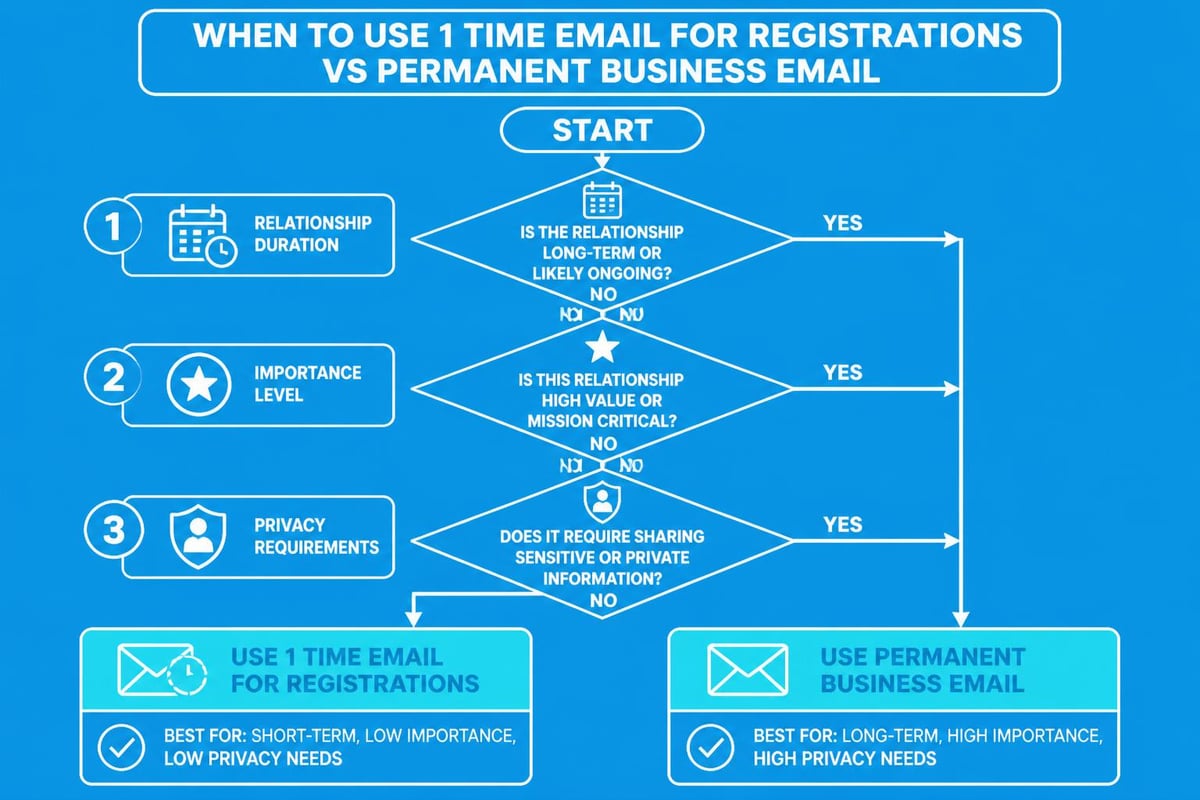
Establishing clear guidelines helps your team use 1 time email effectively without confusion. Consider developing a simple decision tree that helps staff determine when to use permanent versus temporary addresses.
Your procedure might specify that 1 time email is appropriate for:
- Initial vendor inquiries before relationship establishment
- Content downloads from unfamiliar sources
- Event registrations for preliminary exploration
- Testing competitor services and offerings
- One-off transactions with no anticipated follow-up
Meanwhile, your permanent business email address should be used for all customer interactions, partner communications, and ongoing business relationships.
Integration with Your Email Marketing Strategy
Interestingly, understanding 1 time email usage helps inform your own email marketing approach. Recognising that prospects might use temporary addresses when first engaging with your business should influence how you structure your welcome sequences and early communications.
Deliver immediate value in your first few messages, as some subscribers might be evaluating your content through temporary addresses. If your initial emails provide genuine insight rather than purely promotional content, you increase the likelihood that temporary address users will re-subscribe with their permanent email once they've assessed your value proposition.
This understanding shapes how you approach email marketing for small businesses, focusing on building trust quickly rather than assuming unlimited time to nurture relationships.
Technical Considerations and Best Practices
Choosing Reliable 1 Time Email Providers
Not all temporary email services offer equivalent security or reliability. When selecting a provider for business use, evaluate these critical factors:
| Evaluation Criteria | Why It Matters | Questions to Ask |
|---|---|---|
| Encryption standards | Protects message content | Is TLS/SSL encryption used? |
| Privacy policy | Defines data handling | Do they sell user data? |
| Service uptime | Ensures message receipt | What's their reliability record? |
| Expiration controls | Matches your needs | Can you set custom timeframes? |
| Message forwarding | Enables longer retention | Can you forward to permanent email? |
Research from experts examining whether temporary email services can be hacked suggests that whilst vulnerabilities exist, reputable providers implement reasonable security measures. The primary risk comes from choosing unreliable services or using them inappropriately.
Managing Multiple Temporary Addresses
As your business grows, you might generate numerous 1 time email addresses for different purposes. Maintaining a simple tracking system prevents confusion about which address was used for which service.
A basic spreadsheet can track:
- The temporary email address used
- Purpose or service it was created for
- Date created and expiration date
- Whether any important information was received
- Status (active, expired, forwarded to permanent email)
This documentation proves particularly valuable if you need to reference a confirmation email or access a service weeks after initial registration. Without tracking, temporary addresses quickly become orphaned and forgotten.
Avoiding Common Pitfalls
Small businesses sometimes encounter challenges when implementing 1 time email practices. Common mistakes include:
Using temporary addresses for password resets: If you register an account with a 1 time email and later need to reset the password, you'll be locked out once the temporary address expires. Always migrate important accounts to permanent email addresses.
Forgetting to capture critical information: Confirmation numbers, licence keys, or access credentials sent to a 1 time email must be saved elsewhere before expiration. Develop a habit of immediately forwarding important messages to your permanent inbox.
Over-reliance on anonymity: Whilst 1 time email provides privacy, it shouldn't be used to evade legitimate accountability. Businesses maintaining ethical practices use these tools for efficiency and security, not to avoid responsibility.
Advanced Strategies for Email Management
Combining Temporary and Permanent Email Systems
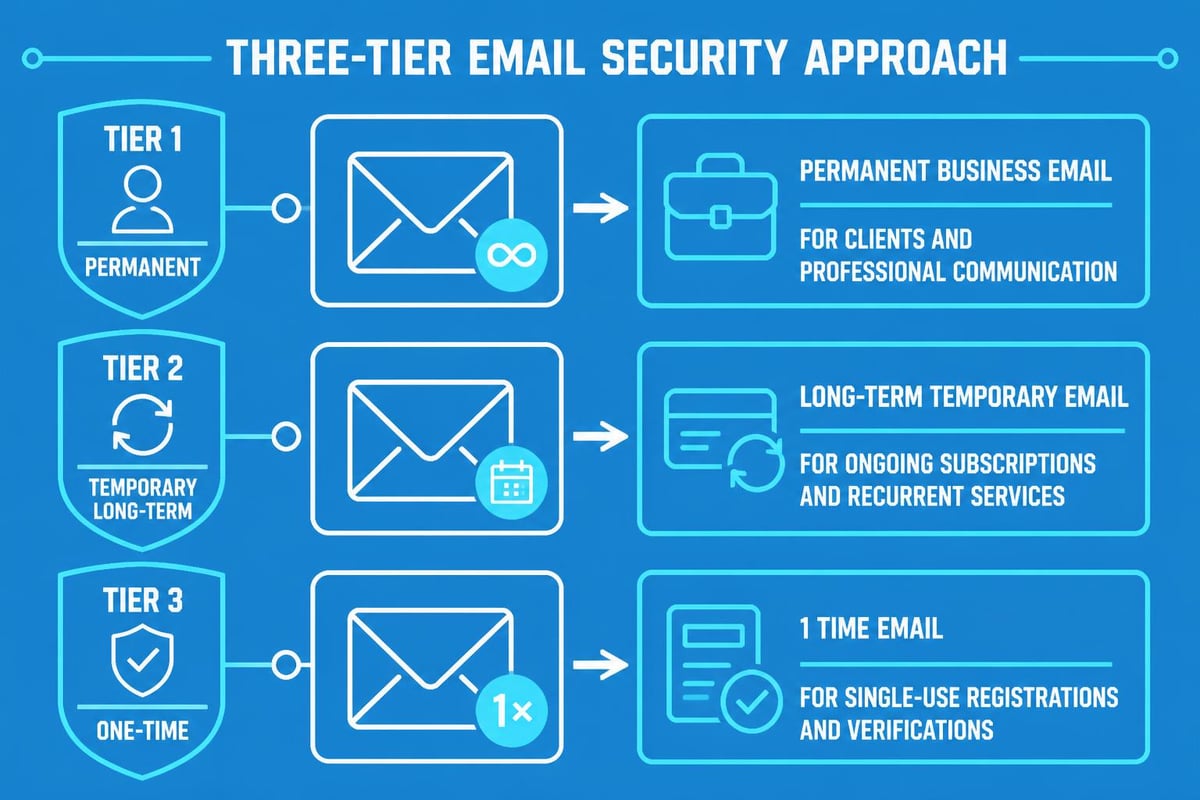
Sophisticated small businesses often implement a three-tier email approach: permanent business email for clients and critical communications, standard temporary email for ongoing but non-critical subscriptions, and 1 time email for singular transactions.
This layered strategy, detailed in comparisons of temporary versus permanent email, optimises both security and functionality. Your primary business email remains pristine and focused, your standard temporary addresses handle medium-term subscriptions, and your 1 time addresses provide maximum flexibility for exploratory activities.
When implementing this approach through Astonish Email's platform, you can maintain clear segmentation between these communication tiers whilst managing everything from a unified interface.
Automated Workflows and Time-Saving Techniques
For businesses handling substantial email volume, automation becomes essential. Consider these efficiency-enhancing approaches:
- Set up filters that automatically forward critical messages from temporary addresses to permanent storage
- Use browser extensions that generate 1 time email addresses instantly without visiting provider websites
- Create templates for common scenarios where temporary addresses are appropriate
- Implement team protocols that automatically document temporary address usage in shared systems
These workflows ensure that the security benefits of 1 time email don't come at the cost of operational inefficiency. The goal is seamless integration into daily business processes rather than adding administrative burden.
Future Trends in Temporary Email Technology
The temporary email landscape continues evolving in response to changing business needs and security threats. Emerging trends for 2026 include:
Enhanced integration capabilities: Modern temporary email services increasingly offer API access, enabling businesses to programmatically generate and manage 1 time email addresses within their existing systems and workflows.
Improved forwarding and filtering: Rather than simply receiving messages at a temporary address, newer services provide sophisticated filtering that automatically categorises and routes messages to appropriate permanent addresses based on content and sender.
Blockchain-based verification: Some providers are exploring decentralised identity verification systems that combine the privacy of temporary email with enhanced security through blockchain technology.
AI-powered threat detection: Advanced services now analyse incoming messages to temporary addresses for phishing attempts, malware, or other threats before any forwarding occurs.
As discussed in comprehensive guides to temporary email services, the technology adapts continuously to address both user needs and emerging security challenges.
Regulatory Developments Affecting Temporary Email
Privacy regulations continue expanding globally, potentially affecting how businesses use temporary email services. The key is ensuring your usage aligns with both the spirit and letter of data protection laws.
GDPR, CCPA, and similar frameworks generally support the principle of data minimisation that temporary email enables. However, businesses must ensure they're not using these tools to circumvent legitimate data subject rights or evade regulatory obligations.
Staying informed about regulatory developments helps ensure your 1 time email practices remain compliant whilst delivering intended benefits. Professional guidance from legal experts familiar with your specific jurisdiction and industry provides additional assurance.
Measuring the Impact of 1 Time Email Usage
Quantifying Security Benefits
Whilst some advantages of 1 time email are immediately apparent, others require measurement to fully appreciate. Consider tracking these metrics:
- Spam reduction percentage: Compare spam received at your primary business email before and after implementing 1 time email for registrations
- Time saved on email management: Measure hours spent sorting and deleting irrelevant messages
- Data breach exposure reduction: Calculate how many services you've registered with using temporary versus permanent addresses
- Marketing campaign insights: Track how many test emails you can process without cluttering your main inbox
These quantifiable metrics help justify the minor additional effort required to implement 1 time email practices, particularly when presenting security initiatives to stakeholders or team members.
Evaluating Operational Efficiency
Beyond security, 1 time email impacts business efficiency. Teams can research competitors, evaluate software, and explore new opportunities without the cognitive burden of an overflowing inbox. This psychological benefit, whilst harder to measure, significantly affects productivity and decision-making quality.
When evaluating email benefits for your business, consider both tangible and intangible impacts. The peace of mind knowing your primary email remains focused on critical communications represents genuine value, even if it doesn't appear in traditional metrics.
Implementing 1 time email practices provides small businesses with powerful tools for protecting privacy, enhancing security, and maintaining inbox focus in an increasingly complex digital landscape. By understanding when and how to deploy temporary addresses strategically, you can engage confidently with new opportunities whilst safeguarding your primary business communications. Whether you're testing marketing campaigns, evaluating new vendors, or exploring industry events, Astonish Email provides the robust email marketing infrastructure small businesses need to communicate effectively whilst maintaining security and efficiency across all your email initiatives.