Email for 10 Minutes: Quick Productivity Guide 2026
May 10, 2026
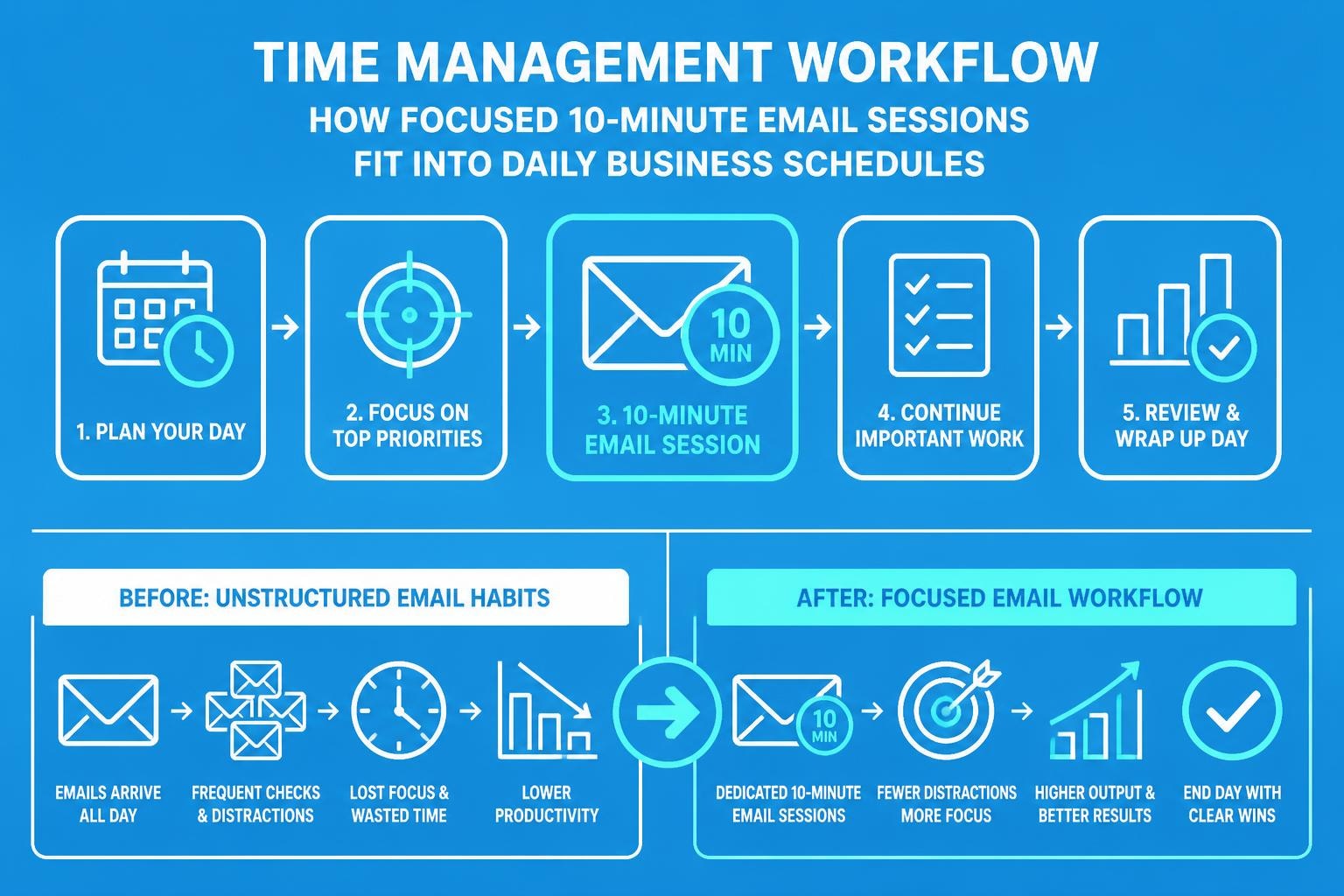
Email management remains one of the most challenging aspects of running a small business in 2026. The constant ping of notifications, the endless stream of messages, and the pressure to respond immediately can derail even the most focused workday. However, implementing a structured approach where you dedicate specific time blocks to email for 10 minutes can transform your productivity and reduce the overwhelming nature of inbox management. This technique combines time-blocking principles with strategic email handling to help small business owners regain control of their schedules whilst maintaining professional communication standards.
The Science Behind Time-Limited Email Sessions
Research consistently demonstrates that focused, time-limited work sessions produce superior results compared to scattered, reactive approaches. When you commit to checking email for 10 minutes at designated intervals, you create boundaries that protect your deeper work whilst ensuring important communications receive attention.
The human brain operates more efficiently when given clear parameters. A defined 10-minute window creates urgency that sharpens decision-making and reduces procrastination. You're less likely to fall into the trap of reading non-essential newsletters or crafting unnecessarily lengthy responses when the clock is ticking.
Psychological Benefits of Structured Email Time
Time constraints force prioritization. During a brief email session, you naturally gravitate towards messages that genuinely require immediate attention whilst postponing less critical items. This automatic triaging happens subconsciously when you know your window is limited.
Key psychological advantages include:
- Reduced decision fatigue through clear time boundaries
- Lower anxiety from constant email monitoring
- Improved focus during non-email working periods
- Enhanced sense of control over your workday
- Better work-life balance through defined communication windows
Small business owners often report feeling chained to their inboxes, believing they must respond instantly to every message. The email for 10 minutes approach challenges this assumption and proves that strategic, scheduled responses often produce better outcomes than reactive, immediate replies.
Implementing Your 10-Minute Email Strategy
Successfully adopting this technique requires more than simply setting a timer. You need systems, tools, and clear protocols that maximize what you accomplish within each brief session.
Setting Up Your Email Environment
Before beginning your first 10-minute session:
- Turn off all email notifications outside scheduled times
- Create folders or labels for quick message sorting
- Establish templates for common responses
- Set up filters to automatically categorize incoming messages
- Configure your email signature to manage response expectations
Your email client should work for you, not against you. Modern platforms like those designed for professional email communication offer features specifically built for time-efficient management.
The Four-Action Email Framework
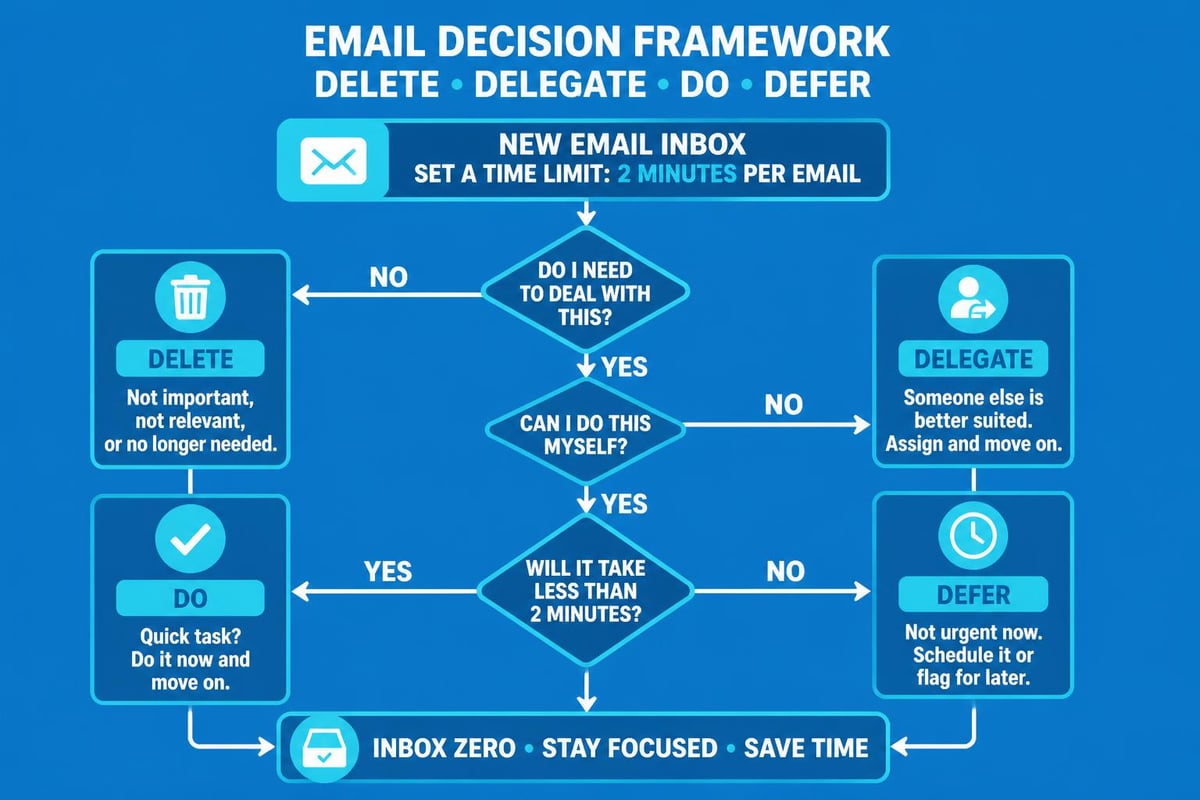
During each 10-minute session, every email should receive one of four actions. This decision framework prevents the common trap of repeatedly opening and closing the same messages without taking action.
| Action | When to Use | Time Investment |
|---|---|---|
| Delete | Irrelevant, spam, outdated information | 2 seconds |
| Delegate | Someone else better suited to respond | 30 seconds |
| Do | Quick responses requiring under 2 minutes | 1-2 minutes |
| Defer | Complex issues needing research or thought | 15 seconds to flag |
The key is making an immediate decision. If an email requires more than two minutes to handle properly, flag it for a dedicated work session outside your email for 10 minutes block. This maintains the integrity of your time boundary whilst ensuring nothing important falls through gaps.
Temporary Email Addresses for Different Purposes
Not all communications deserve access to your primary business inbox. Strategic use of temporary email addresses can significantly reduce clutter and protect your main email for 10 minutes sessions from unnecessary distractions.
For small businesses, temporary email services offer valuable privacy protection when signing up for trials, downloading resources, or registering for one-time events. These addresses prevent your primary inbox from becoming overwhelmed with marketing messages and newsletters.
When to Use Temporary Email Addresses
Consider temporary addresses for:
- Free trial registrations and software demos
- Downloading white papers or industry reports
- One-off vendor communications
- Testing marketing campaigns before full rollout
- Attending webinars or virtual conferences
Services like Guerrilla Mail provide disposable addresses that receive messages without requiring personal information. This approach keeps your primary business email clean and focused on genuine customer communications and essential business correspondence.
However, security considerations matter. Understanding email authentication protocols and vulnerabilities helps you make informed decisions about when temporary addresses are appropriate versus when your official business email is necessary for building trust and maintaining professional relationships.
Optimizing Your 10-Minute Sessions for Maximum Impact
The difference between productive and frustrating email sessions often comes down to preparation and technique. Small adjustments to your approach can dramatically increase what you accomplish within each brief window.
Pre-Session Preparation
Successful business owners treat each email for 10 minutes session like a focused meeting with clear objectives. Before starting your timer, take 30 seconds to identify your priorities for that particular session.
Morning sessions typically focus on:
- Urgent client communications from overnight
- Team coordination for the day ahead
- Time-sensitive opportunities requiring immediate response
Midday sessions often handle:
- Follow-ups on morning conversations
- Internal team communications
- Scheduled responses to less urgent matters
End-of-day sessions concentrate on:
- Clearing any remaining urgent items
- Setting up tomorrow's priorities
- Brief responses acknowledging receipt of late-arriving messages
Tools and Technology Supporting Brief Email Sessions
The right technology stack makes email for 10 minutes sessions significantly more effective. Modern email marketing platforms designed for small businesses incorporate features specifically supporting time-efficient communication management.
Essential Email Management Features
| Feature | Benefit | Impact on 10-Minute Sessions |
|---|---|---|
| Smart filtering | Auto-sorts by priority | Saves 2-3 minutes per session |
| Response templates | Pre-written common replies | Reduces response time by 60% |
| Scheduled sending | Compose now, send later | Allows batch processing |
| Read receipts | Confirms delivery and viewing | Eliminates follow-up emails |
| Mobile optimization | Access anywhere | Enables flexible session timing |
When creating a business email account, prioritize platforms offering these efficiency features. The time saved across multiple daily sessions compounds significantly over weeks and months.
Security in Automated Email Management
As businesses increasingly rely on automated systems and AI-driven tools, understanding security implications becomes crucial. Recent research on LLM-driven email agents highlights potential vulnerabilities in automated email management systems that small businesses should consider when selecting tools.
Your brief email sessions should never compromise security for speed. Always verify sender authenticity before clicking links or downloading attachments, regardless of time pressure. Modern platforms incorporate authentication measures that help protect against spoofing whilst maintaining efficient workflows.
Building Email Habits That Support Business Growth
Sustainable productivity requires habits rather than heroic daily efforts. The email for 10 minutes approach works best when integrated into broader business communication strategies that support growth without overwhelming your schedule.
Daily Email Scheduling Framework
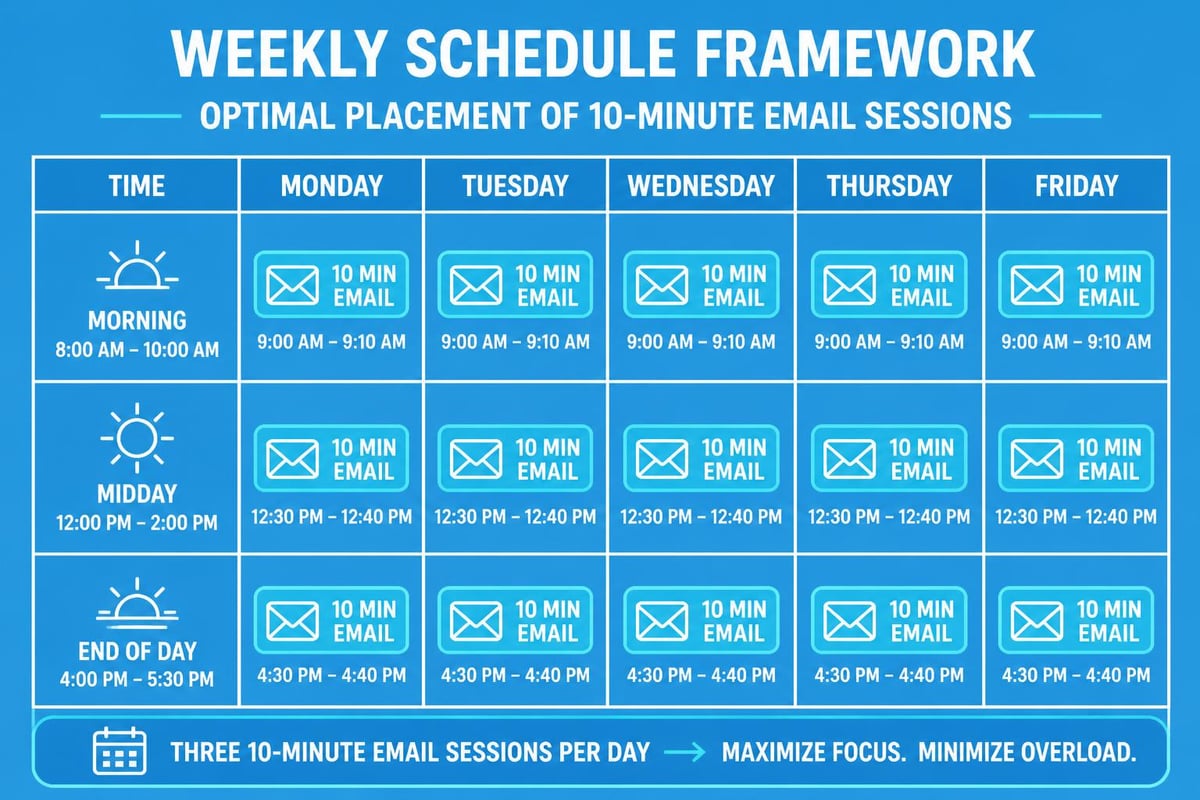
Most small business owners benefit from three to five scheduled email sessions daily. The specific timing depends on your industry, customer base, and personal energy patterns.
Recommended daily structure:
- Early morning check (7:00-7:10): Catch urgent overnight messages before team arrives
- Mid-morning review (10:30-10:40): Handle first wave of daily communications
- Post-lunch session (14:00-14:10): Address midday inquiries and follow-ups
- Late afternoon review (16:30-16:40): Final urgent items before close of business
- Optional evening scan (18:30-18:40): Quick check for emergencies only
This structure ensures nothing critical goes unnoticed whilst protecting five to six hours of uninterrupted work time for deep, focused activities that actually grow your business.
Communicating Your Email Boundaries
Setting boundaries only works if colleagues, clients, and partners understand your approach. Your email signature should include information about response timeframes, setting appropriate expectations without appearing unprofessional.
Consider language such as: "I check email at scheduled intervals to provide focused attention to your message. Typical response time is within 4 hours during business hours. For urgent matters, please ring [phone number]."
This transparency actually enhances professional business communication by managing expectations and demonstrating organizational competence. Clients appreciate knowing when to expect responses rather than wondering if their message disappeared into the void.
Advanced Techniques for Power Users
Once you've mastered basic 10-minute email sessions, advanced techniques can further optimize your communication efficiency whilst maintaining the time-bounded approach.
Batch Processing Similar Messages
Group similar types of emails and handle them together within your session. Responding to five customer inquiries consecutively is faster than switching between different message types because your brain maintains the same context and response framework.
Effective batching categories include:
- Customer support inquiries
- Vendor communications
- Internal team updates
- Marketing and promotional decisions
- Administrative and scheduling matters
This approach reduces the cognitive switching cost that drains energy and slows response times. Your tenth customer response in a batch typically takes half the time of your first because you've entered a rhythm and established mental templates.
Keyboard Shortcuts and Quick Commands
Mastering keyboard shortcuts transforms email efficiency. Learning just five essential shortcuts can save 2-3 minutes per session, effectively extending your productive time by 20-30% without actually spending more time.
Common productivity shortcuts across most email platforms include compose new message, reply, reply all, forward, and archive/delete. Platform-specific shortcuts for labelling, flagging, and moving messages to folders add additional speed.
Measuring Success and Adjusting Your Approach
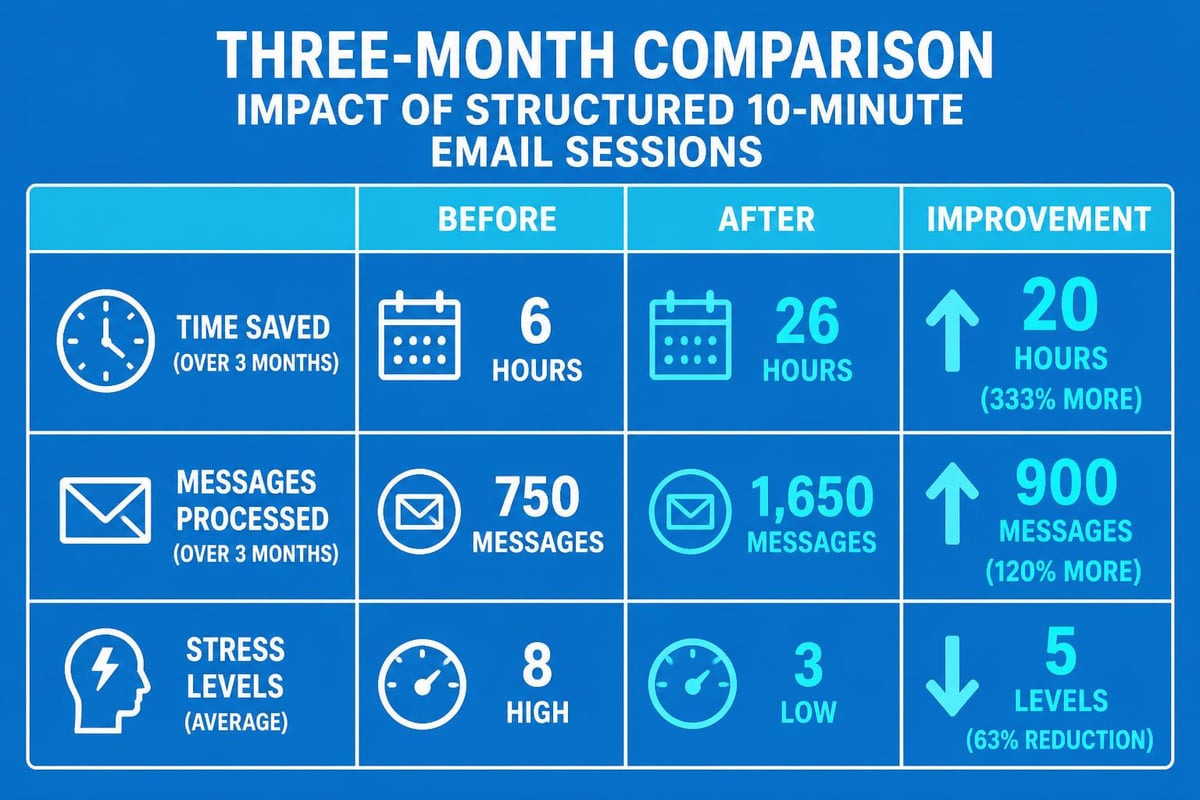
Like any business strategy, your email for 10 minutes system requires periodic evaluation and adjustment based on results. Track key metrics to understand whether your approach delivers the intended benefits.
Key Performance Indicators
Monitor these metrics monthly:
- Average emails processed per 10-minute session
- Percentage of inbox achieving zero (or near-zero) unread messages
- Time saved compared to previous reactive email habits
- Stress levels and work-life balance improvements
- Client satisfaction with response times
Most small business owners find they process 15-25 emails per 10-minute session once the system becomes habitual. If your numbers fall significantly below this range, investigate potential obstacles such as overly complex filing systems, lack of templates for common responses, or insufficient pre-session preparation.
Adapting for Business Growth
As your business grows, your email volume typically increases. Rather than lengthening sessions, consider adding an additional scheduled session or delegating certain email categories to team members.
Understanding how to set up effective business email systems becomes increasingly important as you scale. Proper infrastructure supports efficient communication management regardless of volume increases.
Integration with Broader Productivity Systems
Email for 10 minutes works best as part of comprehensive productivity framework rather than an isolated technique. Integration with task management, calendar blocking, and project coordination systems multiplies the benefits.
Connecting Email to Task Management
When you defer an email requiring substantial work, immediately convert it into a task within your project management system. This ensures the item receives proper attention during dedicated work blocks whilst keeping it out of your inbox.
Effective email-to-task workflow:
- Identify email requiring more than 2 minutes during your session
- Create task in your project management system with context
- Set appropriate deadline based on urgency
- Archive email to clear inbox
- Handle task during appropriate deep work session
This approach maintains inbox clarity whilst ensuring important items receive proper attention at the right time. Your email becomes a communication tool rather than a task management system, which is its intended purpose.
Calendar Blocking for Email Sessions
Physical calendar blocks for your email sessions prevent meeting encroachment and reinforce the habit. Treat these 10-minute windows as seriously as client meetings or important calls.
When colleagues request meetings that conflict with your scheduled email time, you can honestly say "I have another commitment at that time" because you do – a commitment to efficient communication management that serves everyone you work with.
Common Pitfalls and How to Avoid Them
Even with the best intentions, several common mistakes can undermine your email for 10 minutes strategy. Recognizing these traps helps you maintain effectiveness over the long term.
The "Just One More" Trap
Perhaps the most common pitfall is extending sessions because "just one more email" needs attention. This seemingly minor violation erodes the entire system. The discipline of stopping at 10 minutes, even with unfinished items, is crucial.
If you consistently run over time:
- Reduce ambition for what each session should accomplish
- Improve pre-session prioritization
- Create better templates for common responses
- Consider whether some categories should be delegated
- Add an additional session rather than extending existing ones
Letting Urgent Override Important
Email naturally gravitates towards urgent matters, but business growth comes from important work, which is often not urgent. Ensure your email for 10 minutes sessions support rather than replace deep work on strategic initiatives.
Use your sessions to handle genuine urgency whilst deferring important but non-urgent items to dedicated work blocks where they receive proper attention. This distinction separates reactive businesses from proactive ones.
Neglecting Email Quality for Speed
Time limits should never compromise communication quality. A poorly written rushed response can damage relationships and create more work through clarification requests. If you cannot respond properly within your time constraints, defer the email to a dedicated session.
Research on secure email system usability demonstrates that user experience and communication clarity matter significantly for effective business relationships. Speed without quality is counterproductive.
Email for 10 Minutes Across Different Business Contexts
Different industries and business models may require adaptations to the basic email for 10 minutes framework whilst maintaining core principles.
Service-Based Businesses
Professional service providers often face time-sensitive client communications requiring immediate attention. For these businesses, morning and end-of-day sessions might extend to 15 minutes whilst maintaining shorter midday checks.
The key is consistency and clear communication with clients about response timeframes. When managing client email contacts effectively, clients adapt to your schedule when it's clearly communicated and consistently maintained.
E-commerce and Retail
Product-based businesses may need additional sessions during peak hours or promotional periods. However, the time-bounded principle remains valuable even if session frequency increases temporarily.
Consider implementing temporary team coverage during high-volume periods rather than abandoning structured sessions entirely. This maintains individual productivity whilst ensuring customer service standards.
Agencies and Creative Firms
Project-based businesses benefit from coordinating email sessions with project phases. During active client collaboration periods, more frequent sessions support responsiveness. During deep creative work phases, fewer sessions protect focus time.
The flexibility to adjust whilst maintaining structure is the hallmark of mature email management systems that support rather than constrain business operations.
Implementing email for 10 minutes sessions transforms how small business owners manage communications, reducing stress whilst improving response quality and protecting time for growth-focused activities. By combining time-blocking discipline with strategic tools and clear processes, you create sustainable communication habits that scale with your business. Whether you're just getting started with business email or refining existing systems, Astonish Email provides the infrastructure small businesses need for efficient, professional communication management that supports growth without overwhelming your schedule.